For a hundred years, the answer to every municipal water problem has been the same: dig deeper wells, lay more pipes, build a bigger plant. It is a strategy with the subtlety of a backhoe, and in 2026, it is finally hitting a wall.
Between aging lead pipes, PFAS “forever chemicals,” and droughts that no longer bother reading the calendar, cities and counties are staring down a multi trillion dollar infrastructure crisis. The old playbook says build more pipes. But forward thinking municipalities have started doing something radical. They are looking up instead of down.
Welcome to the Blue Green Revolution.
Atmospheric water generation, also known as AWG, gives local governments a way to leapfrog the limits of the traditional water grid by pulling pure, mineralized drinking water straight out of the humidity in the air. It is a decentralized solution that helps cities earn their Green City credentials while quietly solving the water security problems keeping planners up at night.
No new trench required.
Why decentralized water infrastructure beats build more pipes
Most municipal water systems were engineered for the 20th century, and it shows. They lean on enormous, centralized treatment plants and thousands of miles of buried pipe, infrastructure that is prone to leaks, contamination, and eye watering maintenance bills.
The American Society of Civil Engineers reports a water main break somewhere in the United States roughly every two minutes, quietly flushing trillions of gallons of already treated water into the ground each year.
That is not a leak. That is a slow motion bank robbery.
AWG offers cities a way to transition to a decentralized water model. By placing atmospheric water generation units at strategic points such as parks, government buildings, community centers, and schools, municipalities can deliver clean water exactly where people need it without laying a single new pipe.
This plug and play infrastructure lightens the load on central systems and lets cities grow surgically and sustainably, instead of praying the pipe from 1974 holds one more winter.
Skipping the legacy pipe problem entirely
Here is the uncomfortable truth every water director knows. You can run a world class treatment plant and still lose the public’s trust the moment the water leaves it. Between the plant and the tap sit decades of old pipe, pipe perfectly happy to donate a little lead, copper, and microplastic to the cause on the way to someone’s kitchen.
Then there is PFAS. The rise of forever chemicals has forced municipalities into brutally expensive filtration upgrades, chasing contaminants they did not put there and cannot fully remove.
Atmospheric water generation sidesteps the soil and the pipes altogether. AWG units draw water from the atmosphere, a source that is inherently free of ground level pollutants. From there, multistage filtration and UV sterilization make sure the water is not merely safe. It outperforms most bottled brands on the shelf.
The payoff is simple and powerful. Even a city’s most vulnerable residents get water that is free of legacy contaminants, delivered at the source.
A bottling plant without the bottles
You cannot call yourself a Green City while quietly landfilling a mountain of plastic. Recycling efforts aside, millions of single use water bottles end up in municipal landfills and oceans every day. And for a city, the logistics of stocking bottled water for public events, emergency services, and government offices is both expensive and environmentally embarrassing.
Deploy AWG, and you have essentially installed a bottling plant that skipped the bottles:
Cut the bottled water supply chain and counties see an immediate drop in Scope 3 carbon emissions. That means real, reportable progress toward sustainability targets, with no creative accounting needed.
Resilience: the new baseline for municipal planning
Climate resilience used to be a line item you cut first. Now it is the whole budget conversation. Hurricanes in the Southeast, wildfires in the West, and traditional water system failures are all reminders of how fragile centralized infrastructure can be in the face of power outages and source contamination.
Atmospheric water generation functions like an insurance policy for water security. Because the machines are modular and can run on portable generators or renewables, they keep producing clean water precisely when the main grid taps out.
AWG can also support ecosystem resilience. In California, solar powered units have been proposed to maintain moisture across forested land, fighting fire with fog by proactively hydrating the landscape before it becomes kindling. The same approach works in municipal parks and urban green lungs, keeping vegetation alive through brutal heat waves without raiding the drinking water supply.
Case study: what AWG looks like in a public park
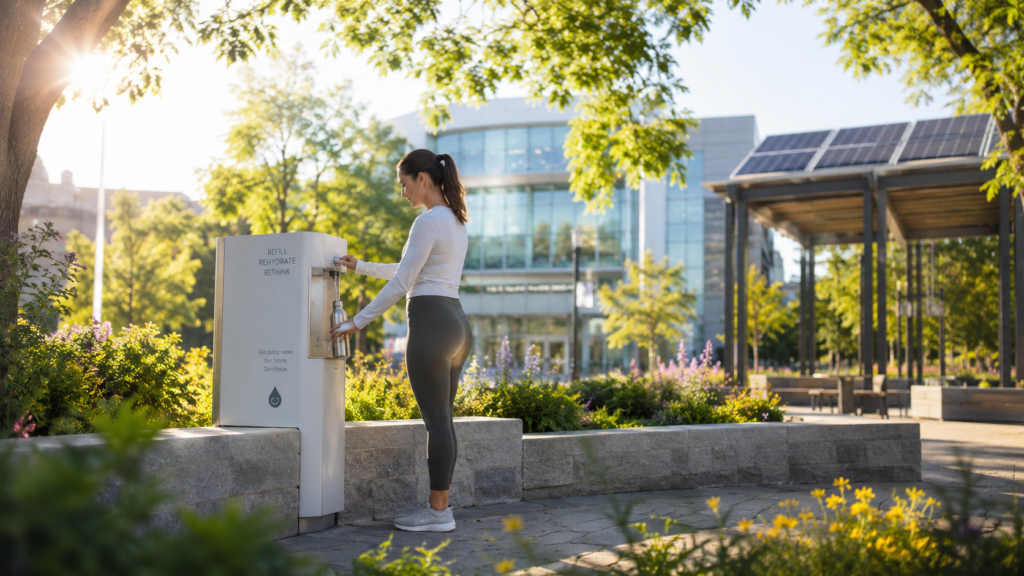
Picture a city park. Instead of the usual drinking fountain wired to century old municipal pipe, there is a sleek AWG kiosk:
That is not just a utility. It is a statement. It tells residents that their local government is betting on innovation, public health, and the environment at the same time. That is how green infrastructure becomes visible on the ground.
The path forward for cities and counties
Going green was never about one heroic gesture. It is a series of smart, scalable infrastructure decisions, and atmospheric water generation is the missing link in a modern municipal water strategy.
It delivers:
As municipalities line up their 2030 sustainability goals, it is worth remembering that the atmosphere is the largest untapped freshwater reservoir on the planet. The technology now exists to help cities and counties tap it.
Ready to lead the Blue Green Revolution?
For municipalities, counties, and public agencies, atmospheric water generation offers a practical way to strengthen water resilience, reduce plastic waste, and modernize public infrastructure without waiting years for new pipes to be installed.